







Information du profil
-

Évaluation d'hôte
100 %
-

Last replied
25 oct. 2026
-

Taux de réponse
100.0 %
Répond généralement ≤ 1 jour
-

Feedback
48
-

E-mail vérifié
Country info
Badges (4)




Trouvez votre hôte idéal




Séjour min. souhaité : Un mois ou plus
Infos
-

Description
Hello!
Are you interested in a volunteer experience in an off-grid community and comfortable with dogs, or even interested in their rehabilitation? Then this could be the right place for you!
We hope you'll read the following text carefully.
WHO WE ARE AND WHAT WE DO
We are an enviromental association located in Sagunto, Valencia (55 km from the center of Valencia) in a rural area with beautiful nature and views in all directions. Our project revolves primarily around the rehabilitation of dogs from diverse backgrounds who need socialization, training, and love to be ready for adoption. We are still in the initial stages, so for now, we are dedicating most of our energy to improving the facilities and living spaces, while also caring for the dogs we have. We are building the foundation to be able to help in the well beign and the recovery of people, animals, and nature itself, and to create a self-sustaining community in the company of the dogs and animals of the project.
We firmly believe in the principles of permaculture and are gradually transforming our land into a self-sufficient garden. We consider ourselves a project with a natural and balanced approach to canine education and rehabilitation. This means we have a patient and mindful approach with each dog, slowly and steadily building their confidence, socializing them, providing them with light training, and giving them a calm and natural environment to regain their equilibrium.
There is a lot of tasks to be done, and we welcome all skill levels. We always try to adapt to each person's abilities and interests as much as possible, as we believe that purpose-driven help always leads to harmony and better results for everyone involved.
We recently changed the title of our project to “Holistic & Integrative Association for the Well-being of Dogs, Humans and Nature”, as this reflects more accurately the direction we are now taking. One of our main goals is to progressively transform the way we care for and treat the dogs that are part of the project, embracing a more holistic and integrative approach. We want to see each animal—and each human being—as a whole, rather than focusing only on suppressing symptoms or fighting the body, and to pay attention to the emotional, mental and environmental factors that may contribute to illness and imbalance.
For us, sustainability also means rethinking our relationship with everyday products and toxins, our ways of doing things, and the systems and ethics behind our everyday choices—not only in hygiene, cleaning, health and permaculture, but also in food, consumption, relationships and the way we live together. We are interested in exploring more conscious and natural ways of caring for ourselves, our animals and our environment, including natural medicines and other alternative approaches available to us. This does not neccesarily apply to dogs belonging to external owners or volunteers, whose decisions and preferences we will always respect. For this reason, in this new stage we are especially interested in welcoming people who share these interests or, at the very least, are open to living and working alongside people who choose this way of life and care.
We believe that true sustainability requires looking at the interconnected whole: the physical, emotional and mental well-being of humans and animals, our relationship with nature, and the systems and values that shape the way we live. This is the direction in which we want to continue growing.
LIVING CONDITIONS
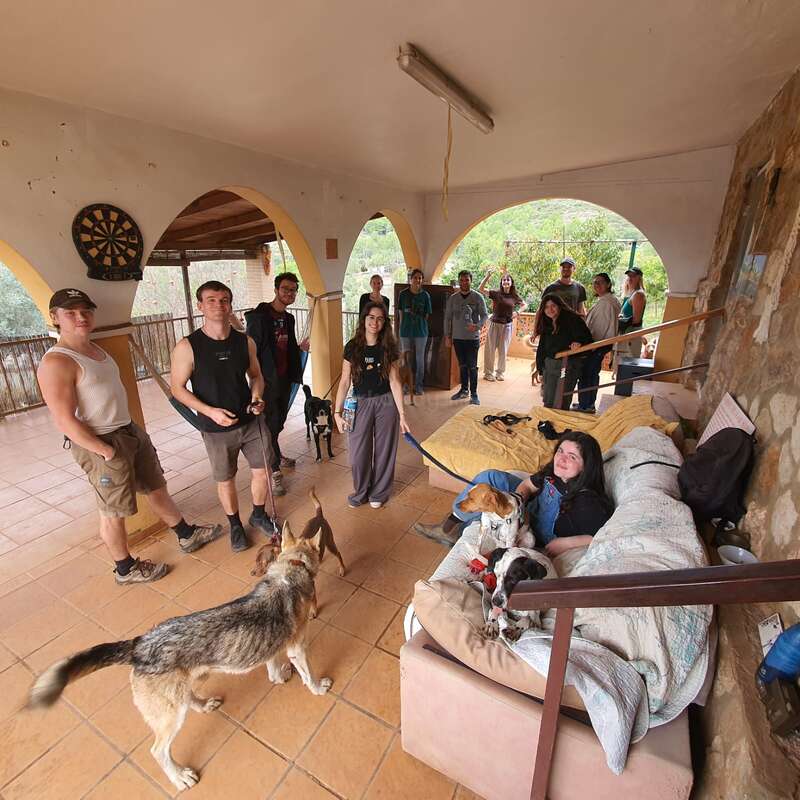
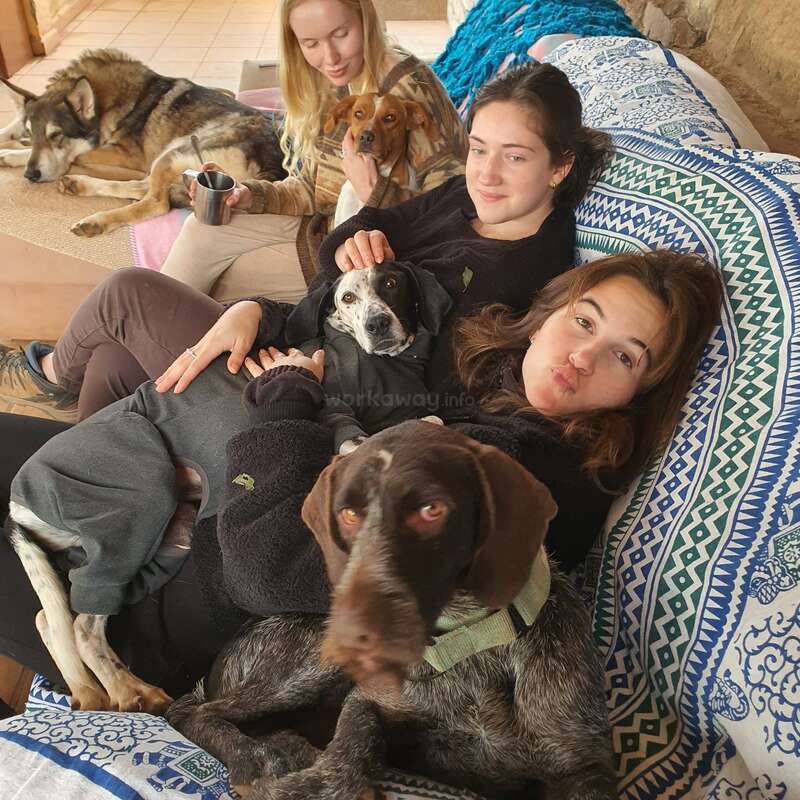
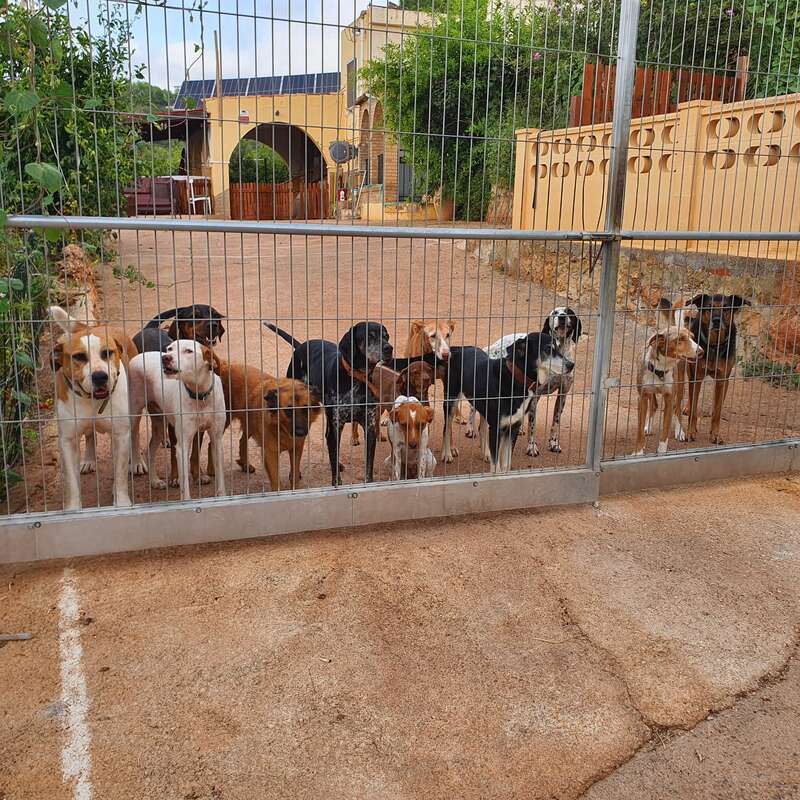
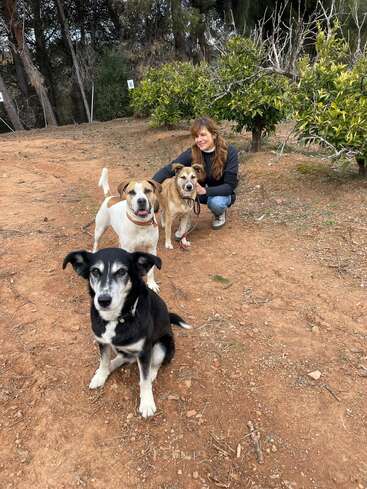
Upon arrival as a volunteer, you will live in what we call the volunteer house; a house that can accommodate up to 8 volunteers in 4 shared double bedrooms, with beautiful views surrounded by nature, a large property, a swimming pool, an outdoor terrace where we eat together, and the house itself with everything you need. You'll live with an adorable pack of sociable and well-behaved dogs , plus three pigs in a landscaped enclosure. Be prepared for canine life and all that it entails: the dogs will bark occasionally, and you'll need to tend to them often and clean up the occasional pee or poop in the house. Many volunteers end up forming special bonds with certain dogs and develop a bedmate or even a foster dog.
Volunteers who stay longer may have the option to move to one of our other houses with individual bedrooms and shared common areas. These volunteers are responsible for the care of the dogs living in these spaces as if they were their own during their time on the project.
The volunteer house is equipped with reliable Wi-Fi, a well-equipped kitchen, and air conditioning for the summer months. The houses are powered by solar panels, so please be mindful of your electricity usage.
It's important to understand that everything is being modernized and remodeled in many ways, and people need to be prepared for that. Some houses are quite far along, others are in a more precarious state, and still others are being renovated. Situations may arise where the electricity, water, gas, or hot water supply is interrupted, but it's usually restored quickly. Here, we're learning to live off-grid, in a rural environment, with all the inconveniences that entails and without the usual comforts of a city home.
HELP
The agreement of help implies: 4 hours a day in the morning and 1 hour after lunch. The afterlunch shift generally dedicated to maintain the houses and spaces clean but it can also be used for walking dogs and other areas of the project. Volunteers will also have to help 1.5 to 1 hour a day on Saturdays and Sundays (Cleaning and feeding the dogs).
We meet at 10:00. We always begin the day with a 30-minute meeting at the volunteer house where we organize tasks, get in touch, and finish with a karaoke song for those who want to join in. From 10:30 to 11:30, we also do tasks all together 2 days a week on a group task; we tackle some of the more physical or tedious tasks together in a more fun and effective way.
At 10:30, we do our morning shifts at the volunteers' house, which are distributed daily and rotated: One shift involves feeding the dogs, walking them, picking up their waste, and filming and making photos of the project dogs. The kitchen shift consists of cleaning the kitchen . Theres also a shift for preparing the meals for the day. Another, more general shift involves filling the generator and doing laundry. Finally, there's the inside shift, which involves cleaning the inside of the house and changing the sofa sheets, among other things.
At 10:30 a.m., we begin the main tasks of the day. Every morning, we present the tasks that need to be done that day, and then people divide up among them. The tasks are very varied, but it generally involves manual tasks such as permaculture, cooking, fencing, gardening, dog care, remodeling, and general maintenance.
There are stages where theres priorities that require everybody to assist, and other stages where it is more free and more people can choose freely what to do from a list of tasks.
The morning tasks ends at 2:30 p.m., which is when we all eat lunch together. In general, it's important to understand that most of the volunteers' help doesn't revolve around the dogs. There is a daily shift for dogs where one or two volunteers go out for walks and spend time with certain dogs that need extra attention, but most of the help at this stage of the project involves improving the space to prepare it for the future rehabilitation center.
Then we have the after lunch help, with the lunch shift for cleaning the dishes and the kitchen after lunch or the outside shift for cleaning outside of the volunteer house and other outdoor areas and spaces. Other shifts include cleaning the porch, the bathroom or poopscooping the pig and dog areas. Theres also a shift for maintenance, organizing and optimizing the space as well as the different walks of the dogs that need more exercice. It's normal for new shifts to arise depending on the project's growing needs.
FOOD
The volunteers prepare the meals themselves. We do a large shop every two weeks, stocking up on a variety of basic items such as vegetables, fruit, beans, rice, nuts etc. It's common for there to be much less variety of food just before the next shop, so we sometimes have to get a little more creative with our meals and cooking.
The association does not use its funds to purchase animal-derived products, products containing gluten, non-fermented soy products or corn, for different reasons related to our values, health and the approach we want to promote as a project.
This does not mean that volunteers are expected to follow the same dietary choices: everyone is free to purchase these products with their own money. However, Meat, fish and gluten-containing products are not allowed in the volunteer house and must be stored, prepared and consumed in other designated areas of the project.
If volunteers want something other than the food provided by the project, they will need to buy it themselves. The nearest grocery store is about 7 km from the project, and the nearest town (La Vall d'Uixó), with shops, cafés, etc., is 13 km away.
VOLUNTEERING AND COMMUNITY LIVING
There are usually about 15-20 of us on the project, so this is the place for people who want to experience community life with other workawayers who share a similar mindset. I prioritize volunteers who plan to stay with the project for an extended period of at least one month. If you plan to stay only a short time, I will most likely reject your application. I prefer to host people long-term, as this makes the experience much more enriching for the animals, the people, and the project itself.
Many people find arriving here overwhelming due to the number of people and the overall impression. So, before deciding to come, keep in mind that you will be living with up to seven other people in a small house, and you will most likely share a room with someone else. The energy is very friendly, but it can be intense. The house is also a space where everyone involved in the project sometimes socializes and cooks, so there are times when things get quite busy. Most people get used to it after a while, but naturally, it's not for everyone. It's important to add that, although we live close to each other, it's perfectly acceptable and normal for people to spend time away from the group (in their rooms, on the forest, taking walks, etc.) when they need space or time alone.
SOCIAL LIFE AND ACTIVITIES
Most of the time, people here end up spending a lot of time together playing board games, doing sports, hiking, taking trips to the city or the beach, etc., and creating close bonds. The activities are organized by the volunteers themselves, and the initiative is always appreciated.
Some of us wake up very early, while others freely share different activities throughout the day, such as breathing exercises, Pilates, yoga, meditation, running, and swimming in the cold pool. If you enjoy these kinds of routines and would like to join us, we'd be delighted to share these moments. In the afternoons, there's also the option of walking some of the dogs from the project along the natural trails in the area, visiting some of the dogs separated from the project and walking them in our fenced area, or spending time with the different packs and socializing with them in the various areas of the project.
We have a car for the project, so afternoons and weekends can also be used for shopping or taking a day trip. We go twice a week to an indoor climbing gym, where we always take a dog so they can socialize and potentially find a home. We also love going to the beach (about 20-30 minutes away) or to Valencia (50 minutes away) for shopping, restaurants, dancing, etc. Since we only have one car, we need to be mindful of sharing it fairly. We use a WhatsApp group to organize car use, and each volunteer will have to pay a deposit upon arrival if they wish to use the car, from which we will deduct driving costs (around €0.2-€0.3 per km, depending on the route).
GOING OUT, ALCOHOL, DRUGS AND SMOKING
Since our long-term goal is to develop as a multispecies rehabilitation and wellbeing center, supporting the recovery and wellbeing of people, animals and the natural environment, we believe it is important to create a space that promotes healthy habits and encourages us to lead by example.
For this reason, the project is drug-free, including alcohol, as we want to maintain an environment where everyone can remain clear-minded and fully present. This is particularly important in an environment where volunteers share responsibilities, care for animals, work with tools and vehicles, and live closely with others.
Our intention is to build a community where alcohol and drugs are not part of our shared lifestyle, whether inside or outside the project. We hope to welcome people who feel aligned with this intention and who are comfortable embracing it, at least during their time here.
We also want to be transparent with people who might come here specifically looking for an environment where absolutely no one drinks alcohol. While this is the reality within the project, and the kind of community we are working to create beyond it, we cannot guarantee the personal choices of every volunteer when they go out, since ultimately those choices are outside our control.
In this regard, we ask everyone to carry this awareness with them when they go out, being mindful of who they are with and of the different processes people around them may be going through. Some may be trying to reduce or leave alcohol or tobacco behind, and we want to foster a culture in which we support and care for one another, rather than making those processes more difficult.
We do welcome volunteers who smoke tobacco or vape. Neither is permitted inside the volunteer house or in the areas surrounding it, but there are designated areas elsewhere in the project where both are allowed.
COMMUNITY EXPECTATIONS
We also want to share an important reflection about the expectations that may arise when coming to the project as a volunteer.
It is natural to imagine that, when joining a community project, you will constantly find yourself surrounded by a group of people doing things allways together, creating, sharing activities, developing projects, and having a very intense sense of community at all times. We would love to always be able to offer that experience, but we believe it is important to understand that the reality of a living community is something more organic and constantly changing.
There are people in the project who live here long-term and who, in addition to being part of the community, have their own personal processes, jobs, responsibilities, and different stages in life. Because of this, there may be periods when there is a lot of activity, connection, and collective energy, while at other times there may be fewer activities and people may be more focused on themselves, their own projects, or their personal processes.
This does not mean that the community is functioning less well. To some extent, it is a natural process in any community: the intensity, energy, and ways in which we connect with one another naturally fluctuate throughout the year.
The experience each volunteer has will also depend on the volunteers who are present at that particular time, their interests, their availability, and the collective energy that emerges between everyone. For this reason, while we want to facilitate spaces, activities, and opportunities for connection, we cannot guarantee that the community experience will be exactly as each person has imagined it.
We believe it is important to come with an open expectation: with a willingness to participate, contribute, suggest ideas, and get to know the people who are part of the project, while also accepting that there will be periods of more movement and others of greater calm and introspection.
For us, being part of a community also means learning to embrace these different rhythms and understanding that community is not something that a few people can create for everyone else, but something we build together with all the people who are present at any given moment.
ENGLISH AS OUR MAIN LANGUAGE
Although this place is located in Spain and some people here speak Spanish, English is the main language of communication within the project. This is why our volunteer information is written in English.
As an international community, volunteers may come from many different countries, and English is the common language that allows everyone to participate and feel included.
Please keep in mind that understanding English in this environment can be more challenging than expected. You may meet people from Australia, New Zealand, the UK or elsewhere, with different accents and ways of speaking. Following spontaneous group conversations, jokes, games, activities or instructions can also be considerably more difficult than having a one-to-one conversation.
We are happy to welcome people who are still learning English, provided they have a sufficient level to communicate and are comfortable with the additional effort involved. There may be moments when you cannot understand everything, especially while simultaneously adapting to a new community and its social dynamics.
At the same time, if you are very comfortable speaking English, we ask you to be mindful of those who are still learning — speaking clearly when needed, being patient and helping make group conversations and activities as inclusive as possible.
We mention this because some volunteers who believed their English would be sufficient have found the everyday communication environment more difficult than expected. Our intention is not to discourage anyone who is still learning, but to help you consider realistically whether you feel comfortable taking on this challenge before coming.
CONNECTIONS AND RELATIONSHIPS
Since so many people live together, close friendships often form quickly, and therefore, it's also possible and natural for connections to develop that go beyond friendship. That said, it's important for us to convey the following message to new volunteers:
For us as a project, it is very important to create a social environment where people respect each other’s time, space, boundaries and emotional wellbeing.
We value mindful and respectful relationships, where people take the time to consider how their choices and connections may affect others, rather than impulsively moving from one connection to another without allowing space for the necessary processes.
We want to welcome people who are able to care not only for their own needs and desires, but also for the social environment and the people around them.
FINAL THOUGHTS AND NEXT STEPS
Thank you for reading. If this project still seems like a good fit for you, I hope to hear from you. Send me a message here on Workaway and I will get back to you as soon as possible. If I consider you a potential candidate, I'll send you a list of questions to answer via a WhatsApp video message. To accept someone, it's essential that I can see and hear them clearly. I need to be confident in their energy and attitude before discussing a possible collaboration. -

Types d'aide et opportunités d'apprendre
 Bénévolat
 Pratique d’une langue
 Aide avec des éco-projets
 Jardinage d'entretien
 Projets DIY créatifs
 S’occuper des animaux
 Aide dans une ferme
 Cuisine/repas pour la famille
 Aide à la maison
 Petits travaux d'entretien
 Aide informatique/internet
-

Centres d’intérêt
 Animaux de compagnie
 Événements/vie sociale
 Végétarien ou végan
 Dev. durable
 Dev. personnel
 Ferme
Ferme Bénévolat
 Soin des plantes
 Musique
 Bricolage / artisanat
 Photographie
 Langues
 Jardinage
 Cuisine et alimentation
 Architecture
 Arts du spectacle
 Auto-stop
 Dessin et peinture
 Menuiserie
 Animaux
 Activités en plein air
 Randonnée
 Plage
Plage Danse
Danse Montagne
 Yoga / bien-être
 Sports d'équipe
 Nature
 Fitness
 Camping
 -

Objectifs de développement durable de l’ONU que cet hôte essaie d'atteindre
-

Echange culturel et opportunités d'apprendre
Learn to slow down and get in touch with nature, community life, dogs, permaculture and DIY projects while helping us creating our dream.
-

Aide
Taking care and walking dogs, cleaning, building, gardening, helping on all kind of DIY projects around the House, the garden and the terrain.
-

Langues
Langues parlées
Anglais: Courant
Français: DébutantCet hôte propose un échange linguistique
Cet hôte a indiqué qu’il souhaitait faire partager sa propre langue ou en apprendre une nouvelle.
Contactez-le pour en savoir plus. -

Hébergement
A house with shared double bedroom and small common área, wifi, light source and views to a Big Green área and mountains.
-

Informations complémentaires
-

Accès Internet
-

Accès Internet limité
-
Nous avons des animaux
-
Nous sommes fumeurs
-
Familles bienvenues
-
-

Possibilité d’accueillir les digital nomads
Cet hôte a indiqué qu’il aimait accueillir les digital nomads.
-

Espace pour garer des vans
Cet hôte a de la place pour les vans.
-

Possibilité d'accueillir les animaux
Cet hôte a dit qu’il acceptait les personnes voyageant avec un animal.
-

Combien de volontaires pouvez-vous accueillir ?
Plus de 2





Discutez avec des workawayers qui ont séjourné chez cet hôte




Feedback (35)
It is very good place to grow and figure stuff out. I hope you will try the experience!
I was attracted to this place initially as I am a huge animal lover, but I knew I needed to be here once I learned how person-centred it also is. Raul has created such a … read more
Photos

Discutez avec des workawayers qui ont séjourné chez cet hôte
Feedback
Ce sont des évaluations supplémentaires en option lorsque les membres laissent un feedback. La note moyenne pour chaque option est affichée.
Exactitude du profil:
(5.0)
Échange culturel:
(5.0)
Communication:
(5.0)
It is very good place to grow and figure stuff out. I hope you will try the experience!
I was attracted to this place initially as I am a huge animal lover, but I knew I needed to be here once I learned how person-centred it also is. Raul has created such a … read more
I initially planned on staying for 2 weeks and ended up staying for 6 months because I couldn’t leave this wonderful place so early.
The dogs, the scenery, the people, everything was amazing. I did a lot of workaways in the last years but this was by far my favorite one.
It … read more
Do it! Go to Spain and visit this beautiful community. I just finished my stay and the other reviews weren't lying: I am absolutely mesmerised and wanting to go back there very soon. If you are looking for positivity, growth, community and good food I 100% recommend for you to go there because there are no words to … read more
Regarding the daily routine, we worked five days a week, usually around four to five hours a day. The morning started with a meeting … read more
From the very beginning, my dog Millie and I were warmly welcomed. We lived in my van for the first few months while being part of the volunteer house … read more
Besides the daily tasks (which are slightly different every day and open for you to choose … read more
It starts with Raul. As others have … read more
I was at an in between phase in my life when I found this place and looking for a rewarding experience. Of course living with a community of dogs sounded fun
But there was something more about this place that I had a good … read more
En este refugio se convive con personas de a mí parecer muy alta calidad y estamos al cuidado de los animales que por distintas circunstancias llegan hasta aquí.
Todos los animales tienen su personalidad y encanto único, es difícil no … read more
Desde el primer momento todo … read more
Todos aquí tenemos en común el amor por los animales y eso hace que se formen equipos de personas motivadas creando un espacio armonioso.
Gracias Raúl por tu energía tranquila y firme.
Gracias Alberto por tus ricas comidas.
Gracias a todos los compañeros.
Y … read more
I very much appreciate the effort of … read more
Raul is truly a man of power of God, he managed to create a beautiful place here, where people meet, animals and everything is in such a beautiful - healing nature. It's so wonderful to see people living their dreams..
The accommodation and the food here are wonderful! lunches are healthy and … read more
I spent a beautiful 2 weeks on the project with Raul, and it was perhaps one of my most enjoyable workaway experiences. I'd recommend it to absolutely anybody. Firstly, the communication running up to and during the project was really smooth and organised, and upon … read more
Surrounded by nature, kind people and animals, being here has been definitely healing. Raul is an excellent host and Alberto cooks the best vegetarian food I have ever tasted. Such a privilege!
Raul is an amazing guy with a wonderful energy. He will listen to any concerns or ideas you have and allows you the freedom to learn and grow your skill set
You are given the freedom to choose from … read more
Raul is an intelligent, lively and funny person, but in top of that he is a very easy person to connect and creat a bound.
From day one, he helped me with my difficulties and made me as comfortable as possible in his project.
Raul's project is very inspiring … read more
The project is very rewarding work on, you will wake up in the morning wanting to work … read more
Raul is also a really nice host as well as … read more
First of all, Raul has good vibes, kindness and positive attitude. You can discuss many different topics and at the same time laugh a lot. On our free days we would go to explore the nature around. There are variety of … read more
This was my first workaway and I wish I had allowed for more time, I was sad to be leaving when I did.
Raul is a wonderful person to get to know, I am very excited for the plans he has in store for creating a wonderful space for the dogs to stay. Raul is a great host … read more
What good times spent with Raoul, we are really delighted, he is a man with a big heart, with many projects, full of ambition. His hideaway is absolutely awesome! There is indeed a lot of work if you are going to engage yourself seriously because it is a super beautiful project it is only love of … read more